Lesson Menu #2
Intermediate & Advanced.
Lesson Menu #3
Advanced & Ultra-Advanced.
Lesson Menu #4
Text lessons: All levels.

PRODUCTS:
GET ALL THE PRODUCTS AT ONE LOW PRICE.

SURPRISES ABOUND . . . For those with a bit of generosity
in their soul.
CLICK HERE , to see what I mean.
Intermediate & Advanced
Drummers
 Your future is waiting.
ALL MUSICIANS
MASTER
ALL RHYTHM,
This FASCINATING WAY!
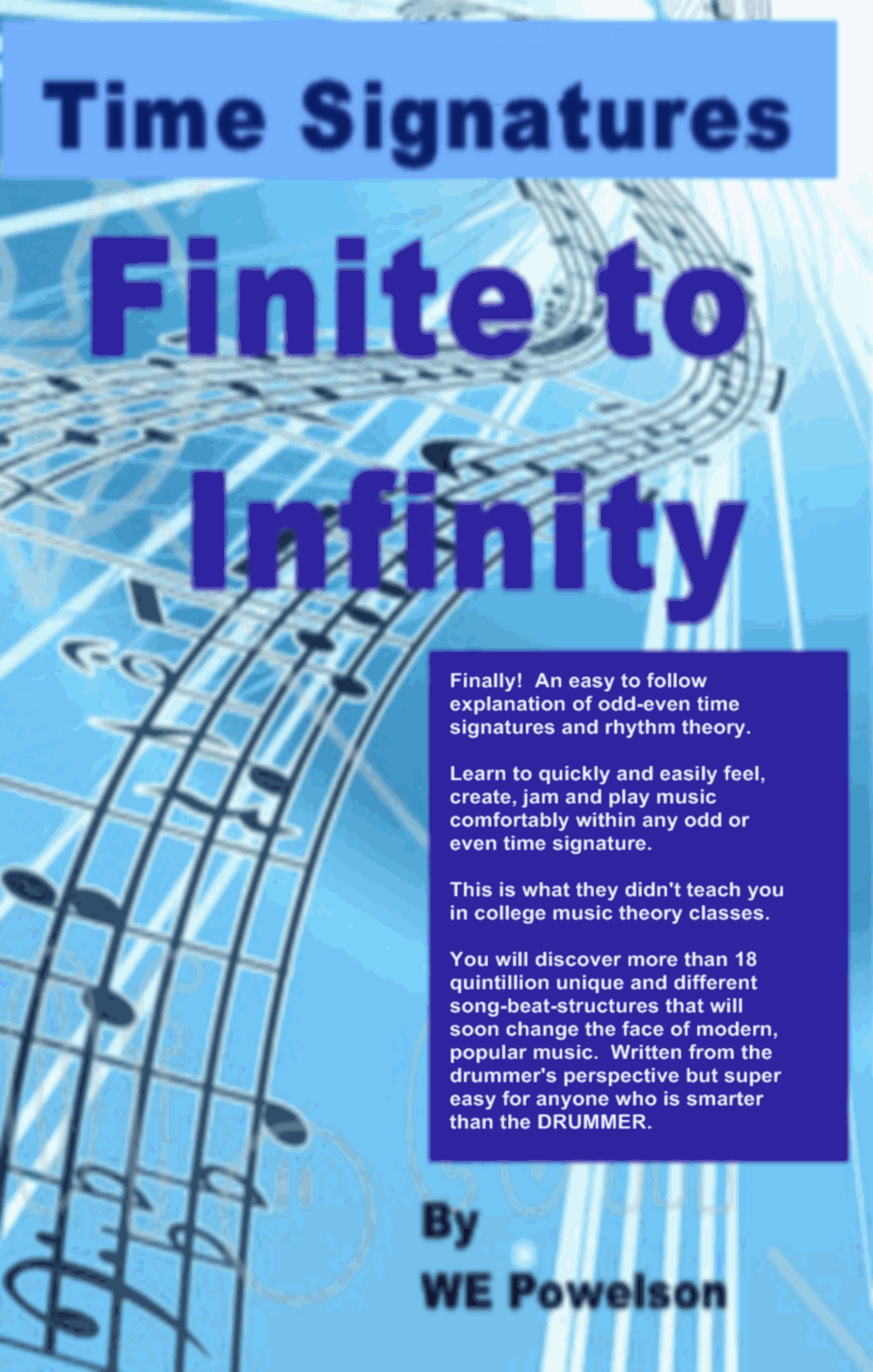 Discover the 'LOST KEY' for Unraveling
ALL the mysteries of rhythm, and musical time.
Discover the 'LOST KEY' for Unraveling
ALL the mysteries of rhythm, and musical time.
This work
is the crowning-achievement of my 50 year career, and it's
my proudest accomplishment.
It contains the potential to help YOU change the face of modern music!
You'll love it! CLICK HERE to check it
out completely! You're in for a MAJOR surprise!
"PRE-SCHOOL DRUMMER?
YES!"
Can we teach rhythm
to pre-schoolers? YES!

This is a very short course,
designed to help adults plant the seeds of rhythm
into children of nearly any age.
CLICK HERE
FREE ELECTRONIC BOOK BONUS (also included)
 BUSINESS OPPORTUNITY:
MAKE BIG MONEY SELLING USED DRUMSETS!
* INSIDER HARDBALL-BUYING-TIPS AND SECRETS.
* UNIQUE RECOVERING SECRETS
Support this site and and gain an advetising bargain with the deal.
 Place a permanent ad here. Place a permanent ad here.
GET ALL THE PRODUCTS AT ONE LOW PRICE.
SURPRISES ABOUND . . . For those with a bit of generosity
in their soul.
CLICK HERE , to see what I mean.
|
|
Downloads *
Drummers Trivia *
Drummers Chat Rooms *
Rudiments *
Digital Music *
Knowledge Assessments *
TD Archives *
Drum Set Buyers Guide *
Bass-Player Jokes *
Assembling a Drum Set *
Parts of a Drum Set *
About HSID *
Video Troubleshooter
Bill Powelson's School of Drums
Understanding Time Signatures
If you've found this lesson . . . Good for you. I no longer
link to it, because I've revised it, and produced the ULTIMATE
E-BOOK for Understanding ALL rhythms, all beat structures, and all beat variations
within the immense time-signature system. It's absolutely awesome
and I'm begging you to check it out, for your own good. It
will turn you into a virtual rhythm guru.
Read about that E-book, here. You won't
regret it.
Meanwhile . . . You can study this page. It will give you the basics,
but time signature studies, when studied my EASIER, BETTER WAY . . . will
offer you 100 times more (easy) knowledge, in a way that will literally
load your mind with 18 quintillion beat patterns. It will
explode your jamming ability on any instrument, by a factor of 10.
My E-book is a brand new (easy) approach to this very deep and complex topic.
It will rival anything you've ever seen concerning time signatures.
~~~ ~~~ ~~~ ~~~ ~~~
What is a Time Signature?
A time signature is fractional looking number, a formula that determines the count in a piece of music. A time signature formula should always precede written notation and may often be used more than once in a song to show any changes in the counting procedure. Think of a time signature as a code telling you how to count and feel a particular rhythm. Let us break that code to reveal its secrets in this way:
4/4 is a common time signature
The top number = 4 = tells how many counts = (May be any number.)
The bottom number = 4 = what kind = (must represent a note value.)
What does this mean?
Our top number here is four. This means that each measure will have four counts. The top number can be any number within reason. Anything more than 64 is considered quite unreasonable.
The bottom number here is also four, indicating quarter notes. This means that each following measure must equal four/quarter notes.
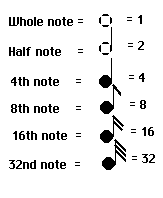
The bottom number must represent a note value. We may figure out note value representations from the following chart:
Notice: A form of triplets will exist between each of the note values below. We will not be concerned with those triplets in this stage of the time signature system. However; the importance of triplets will be obvious a little later when we study the dance beat forms of each time signature.
How many different time Signature formulas are there?
The top number can be any reasonable number. The bottom numbers may be any of the following 1, 2, 4, 8, 16, 32 and so on. No specific limit on the number of formulas has been set as far as I know. To keep everything within reason we will use 32 as an arbitrary stop point. If you understand that much, you will be ready to take on the big guys. So, to state it arbitrarily, you may have time signatures running from 1/1 thru 32/1 all the way through the note value system (bottom numbers 1, 2, 4, 8, 16, 32). The last time signature in this line of thought would be 32/32. Before anyone goes into a complete state of shock, let me say that many of these strange signature formulas are rarely used. About the only logical use for a time signature like 1/4 or 1/8 might be to write a one count exercise in a music method book. Also, many beat replications appear within the system. For drummers this means that we often see the same beat patterns with different time signature formulas. The notation and time signature formula may look different but the beat will often be one with which we are very familiar. For example, check out the waltz beat lesson again. Notice that triplet 3/4 and 9/8 are actually the exact same basic dance beat.
The rest of the story . . .
Most music instruction books drop you off around this point, leaving you to figure out the rest. It is safer that way! The system is immensely complex. I am going to try to take it a lot further but I may show my own ignorance a time or two before I achieve perfection. Bear with me! I am just trying to simplify a very deep and complex subject.
I have compiled most of the following information over many years, teaching, playing, dabbling with computer programming and drum machines. The teaching methods in the later half of this lesson are my own. I am using some explosive ideas in regards to describing rhythms and musical time, from the drummers perspective. If you know of any other book that uses these same ideas, please E-mail the details (Title, author and publisher) to me, so that I may obtain a copy. I will be forever grateful.
Time Signatures into Dance beats
What does all that mean to a drummer?
Sure, we can talk about 15/8 and know that it contains fifteen eighth note counts to the bar. However, most of us want to know how to play it. How do you play 5/4, 7/4 and all the others?
You will be happy to learn that it is not as difficult as you might think. A structure is at work here. It is a very ordered system and if you understand that system, everything will just fall into place. It will hit you in a blinding flash. The other good news is that you already know the hardest part, if you have followed the previous lessons.
Time Signatures, Note Values and Dance Beat Structures:
We will begin with something we already know, then build on it. Think about the 4/4 time signature. We learned in the 'Basic Dance Beats' lesson that 4/4 is made up of many dance beat patterns. Each dance beat pattern, gets its name from the type of note being used on the cymbal line.
Notice: I originally taught these beats in reverse order while illustrating (slow to fast) tempo relationships to beginners.
Now we should structure our basic dance beats this way:
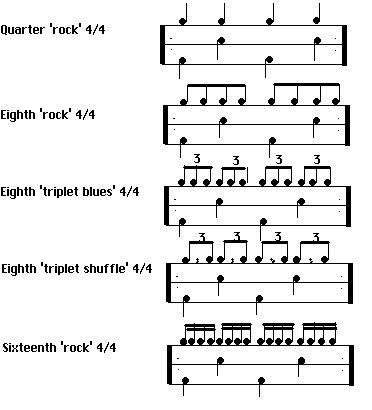
Analyze the 'note value' pattern. Can you see how we structure the basic dance beats in 4/4 time from quarter notes through sixteenths? The basic dance beat system continues thru 64th notes and beyond. We ignored those beats intentionally because of their infrequent use.
The whole system works on this principle!
Use your head and try to visualize the entire system again, one signature formula at a time. Now, reduce each time signature into a hierarchy of dance beat patterns. Don't panic! I will help! Think about 3/4 and the system of dance beat patterns that exist there. You will see the same note value structure repeatedly with every new time signature.
Remember the Waltz beat lesson?
Look at the note value structure; It is the same!. Disregard the 9/8 dance beat in that lesson. 9/8 belongs in the eighth family of signatures and that is another discussion.

The Blinding Flash!
You should see the whole picture now. What comes after 4/4? The answer is 5/4. Can you visualize that dance beat structure? Try writing a few of those patterns. 5/4 is really 3/4 and 2/4 mixed and it does not matter which comes first (see ‘Quarter note 5/4 . . . below). I will help a little by furnishing the first . . . (Quarter note 5/4) and the last . . . (Sixteenth 5/4). You will need to grab a pencil and piece of paper then figure out the beat patterns that fall in the middle. As you are doing this, the entire pattern should unfold.
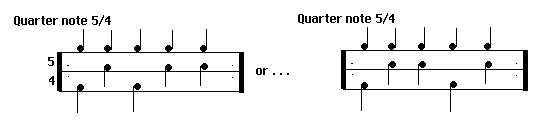
HINT: You will write the following:
- Eighth 5/4
- Eighth 'triplet' 5/4
- Eighth 'triplet shuffle' 5/4 (Do not forget the rests.)
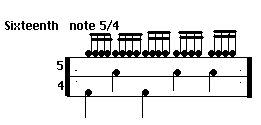
While you are at it, why not examine the following:
- Sixteenth 'triplet' 5/4
- Thirty-second 5/4
- Thirty-second 'triplet' 5/4
- Sixty-fourth 5/4
These later beats are not extremely popular at this time. Who can speak for the future? Imagine a smoking bass guitar riff and screaming guitar ride as you play these patterns. Add a few lyrics, dye your hair purple, put a bone through your nose and you will be ready for the big time!
What is next?
You can figure out the rest on your own. The next signature to study is 6/4. This is an 'even' signature that contains all the same rhythms as 2/4 and 4/4. 6/4 IS those two combined.
NOTE:
If the top number is even (8/4,10/4,12/4,etc.), you will usually be dealing with beat patterns that feel natural.
If the top number is 'odd' (7/4,9/4,11/4, etc.) then the dance beats will have an unsettling lopsided feel like 5/4.
The Big Bombshell!
Did you study the permutations' lesson? Did you totally understand it? We only investigated one basic beat form of 4/4 in that lesson (Eighth 'rock' 4/4.) Do you remember how we discovered 65536 simple variations and over 4.97 billion complex versions of that beat? Can you see how that theory applies to each basic dance beat in 4/4 and ALL the remaining time signature formulas? You should buy two or three pencils, you are going to need them.
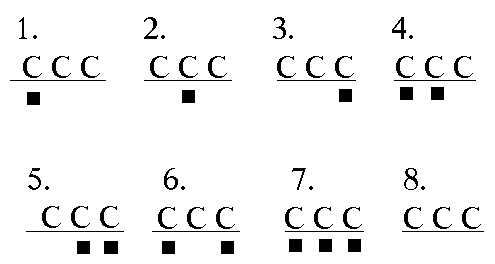
The 'TRI' chart.
In the permutation lesson we used a chart that we called the 'Quad' Chart. To investigate all the beat variation possibilities in the time signature system we will need a couple more charts. The most important additional chart is the 'TRI' chart that will help us investigate the permutation possibilities with triplet-based rhythms.
'TRI' CHART
There may also be a need for another chart that is based on two cymbal notes. Of course we would call this a 'BI' chart.
'BI' CHART
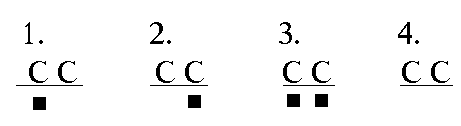
These charts have the effect of illustrating and labeling every dance beat in the time signature system. With this concept, each dance beat has its very own name.
The remaining time signature families?
The remaining time signature forms are based on similar logic. I may add more on them later. You can probably figure it out on your own from here anyway. 3/8 is really a 'waltz' with weird notation. Most of the beats that we have found in the quarter note family of signatures will exist again in all the remaining time signature families. This will include:
- Eighth (1/8 thru 32/8)
- Sixteenth (1/16 thru 32/16)
- Half note (1/2 thru 32/2)
The notations and signature formulas will be different but the underlying beats and permutations will often be the same.
Please check out my latest effort on this topic. It is sooooo much better than what
you've seen here. Finite to Infinity with musical time.

Copyright Bill Powelson 1994 all rights reserved.
| |
